

Fire cider is a spicy apple cider vinegar tonic. You steep garlic, ginger, horseradish, onion, hot peppers and citrus in vinegar for about 4 weeks, strain it, then stir in honey. Most people take about a tablespoon a day, diluted in water or added to food.
This page covers the recipe and what people ask after making it: how long it keeps, how much to take, and what research does and does not say. Every fact links to its source. We also make a Fire Cider shot, and we say so plainly in its own section.
I formulate every Queen Bee shot myself, and our Fire Cider shot borrows from this tradition: apple cider vinegar, ginger and horseradish, with pineapple and lime, finished with raw honey and royal jelly. If you have a quart jar and a month, make the classic below. You control every bit of the heat. Raina Singhvi Jain, Founder
What is fire cider?
Fire cider is a folk tonic of apple cider vinegar infused with pungent roots and peppers, then sweetened with honey. Herbalist Rosemary Gladstar, founder of the California School of Herbal Studies, developed and popularized it in the late 1970s (Healthline).
Home herbalists have tweaked her recipe ever since. In 2012 a company trademarked the name. Herbalists pushed back, and in 2019 a federal court ruled that the name cannot be trademarked (WAMC). Anyone can make it, sell it and use the name.
It tastes hot, sour, sharp and a little sweet. The vinegar pulls flavor out of the roots over several weeks, so a finished batch tastes far deeper than the raw ingredients.
Fire cider recipe
Pack chopped roots, onion, garlic, peppers and citrus into a quart jar, cover with apple cider vinegar, and steep 3 to 4 weeks in a cool, dark place. Most flavored vinegars need at least 10 days, and the strongest flavor takes 3 to 4 weeks (University of Alaska Fairbanks Extension).
The traditional recipe
Yield: about 3 cups · Prep: 20 minutes · Steep: 4 weeks · Total: 4 weeks and 20 minutes
Equipment: 1-quart glass jar, plastic lid (or parchment under a metal lid), grater, cheesecloth or a fine strainer, a clean bottle
Ingredients
- 1/2 cup fresh ginger, grated or finely chopped
- 1/2 cup fresh horseradish root, grated
- 1 medium onion, chopped
- 10 cloves garlic, crushed or chopped
- 1 to 2 jalapeños or other hot peppers, sliced, or 1/4 teaspoon cayenne
- 1 lemon or orange, zested and juiced
- Optional: 1 tablespoon grated fresh turmeric (or 1 teaspoon ground) and 2 sprigs rosemary
- About 3 cups raw apple cider vinegar, 5% acidity or stronger (Healthline)
- 1/4 cup raw honey, or to taste, added after straining
Steps
- Wash the roots, peppers and citrus; grate the horseradish near an open window, since the fumes are strong
- Put everything except the vinegar and honey in the jar, about three quarters full
- Pour in vinegar until the solids are covered by at least 1 inch, and press them down
- Cover with a plastic lid or put parchment under a metal lid, because lids should be non-corrosive (UAF Extension)
- Steep in a cool, dark cupboard for 3 to 4 weeks, shaking once a day
- Strain through cheesecloth and squeeze the pulp hard
- Stir in the honey, taste, and add more if you like
- Bottle it, label it with the date, and refrigerate
How long does fire cider last?
Refrigerate it after straining and finish it within about 3 months. University extension guidance says steeped flavored vinegars keep up to 3 months in cool storage, and that refrigeration keeps freshness and flavor best (UAF Extension).
Throw the whole batch out if you see mold or signs of fermentation, such as bubbling, cloudiness or sliminess (UAF Extension). Healthline is more cautious and suggests drinking it within 2 to 3 weeks (Healthline).
While it steeps:
- Keep every piece under the vinegar; anything poking out can mold
- Use clean jars, hands and utensils
- Do not water the vinegar down before steeping
How do you take fire cider?
The most common amount is 1 tablespoon once or twice a day. Healthline lists 2 to 3 tablespoons spread through the day, or one 1.5 oz (45 ml) shot, and suggests diluting a shot in about a cup of warm water to reduce the burn (Healthline).
Ways people use it:
- Stirred into water or warm water with extra honey
- As the vinegar in a salad dressing, with olive oil and mustard
- Splashed into soups, beans, greens or a marinade
Timing is up to you. Many people take it in the morning or with a meal, and with food is gentler on the stomach. Afterward, rinse your mouth with water and wait at least 30 minutes before brushing your teeth (Healthline). For a sense of daily amounts across shots, see how many wellness shots you can take a day.
Can you drink fire cider every day?
Many people take a tablespoon every day. The limit is the vinegar. Mayo Clinic notes some studies suggest up to two tablespoons of apple cider vinegar a day is acceptable, and warns that acidic drinks can weaken tooth enamel and irritate the throat (Mayo Clinic).
Always dilute it, and cut back if you notice heartburn or stomach pain. Check with your doctor or pharmacist first if:
- You take insulin or a diuretic; vinegar can interact with both and lower potassium (Mayo Clinic)
- You take a blood thinner or have surgery coming up; garlic may increase the risk of bleeding (NIH NCCIH)
- You have acid reflux, indigestion or gastroparesis (Healthline)
- You are pregnant or breastfeeding
- You take any regular medicine; see wellness shots and medication interactions
Never give anything made with honey to a baby under 1 year old, because of the risk of infant botulism (CDC). For older children, ask your pediatrician.
What are the benefits of fire cider?
No published human study has tested the tonic itself (Healthline). People drink it as a warming daily ritual from the home herbalism tradition. What we know comes from studies of single ingredients, mostly in concentrated amounts.
Here is what research on each main ingredient does and does not show.
| Ingredient | What research shows | What it does not show |
|---|---|---|
| Apple cider vinegar | Studies are mostly small or limited (Mayo Clinic) | Meaningful weight loss or long-term appetite control |
| Ginger | Traditionally used for indigestion; research shows it may help with nausea in pregnancy (NIH NCCIH) | Help with motion sickness in most studies |
| Garlic | Most studied for cholesterol; only two small studies on immune function in a 2022 review (NIH NCCIH) | A clear effect on immune function |
| Turmeric | Not enough evidence yet to conclude it is beneficial for any health purpose (NIH NCCIH) | Any confirmed benefit |
| Horseradish and hot peppers | Popular claims rest on lab studies or none (Healthline) | Human trials of those claims |
So the honest answer: it is a flavorful, traditional way to get garlic, ginger, horseradish and peppers into your day. Ginger has the strongest track record of the group. Our post on the side effects of ginger covers who should be careful with it.
Fire cider vs apple cider vinegar shot: what is the difference?
An apple cider vinegar shot is vinegar diluted in water, sometimes with lemon or ginger, made in a minute. The tonic uses the same vinegar but steeps roots and peppers in it for weeks. Both are acidic, and acidic drinks can wear down tooth enamel over time (Mayo Clinic).
The steeped version tastes far more complex: garlic, horseradish and pepper heat on top of the sour. Use the same habits for both: dilute, drink water after, rinse. Deciding between vinegar and ginger? Read apple cider vinegar vs ginger shots for digestion.
Fire cider vs oxymel: what is the difference?
An oxymel is vinegar and honey, often with herbs. The name comes from the Greek "oxymeli," meaning acid and honey, and its use dates back to the time of Hippocrates (Heliyon, 2023 review).
Sweetened with honey, the tonic is a close cousin of an herbal oxymel. The difference is balance. In an oxymel, honey is a main ingredient, and some preparations in that review use far more honey than vinegar. Here the vinegar and roots lead, and honey goes in at the end, to taste.
Is there a quick fire cider recipe?
Yes. Blend the ingredients into the vinegar instead of chopping them, refrigerate 1 to 3 days, then strain and add honey. It tastes brighter and less deep than a 4-week batch.
- Blend 1 cup apple cider vinegar with 2 tablespoons each of chopped ginger and grated horseradish, 2 garlic cloves, 1/4 small onion, a pinch of cayenne and half a lemon's juice
- Pour into a jar, cover with a non-metal lid and refrigerate 1 to 3 days
- Strain, stir in 1 to 2 tablespoons honey, and keep it refrigerated
Need some tonight? Stir 1 tablespoon apple cider vinegar, a little grated ginger, a squeeze of lemon, a pinch of cayenne and honey into a cup of warm water.
Fire cider variations
The base stays the same: vinegar, roots, heat and honey. Keep the total amount of solids about the same so the vinegar still covers them.
- Citrus: orange, grapefruit or lime in place of lemon
- Turmeric and black pepper: piperine from black pepper helps the body absorb curcumin (NIH NCCIH)
- Herbs: rosemary, thyme or oregano sprigs
- Fruit: chopped apple or pineapple for a softer batch
- Milder or hotter: halve the garlic and horseradish, or use a habanero
- Vegan: maple syrup in place of honey
Can you buy fire cider ready-made?
Yes. Since the 2019 ruling, any maker can use the name (WAMC), and many small brands sell bottled versions. Check the label for the vinegar base, sweetener, serving size and storage once opened.
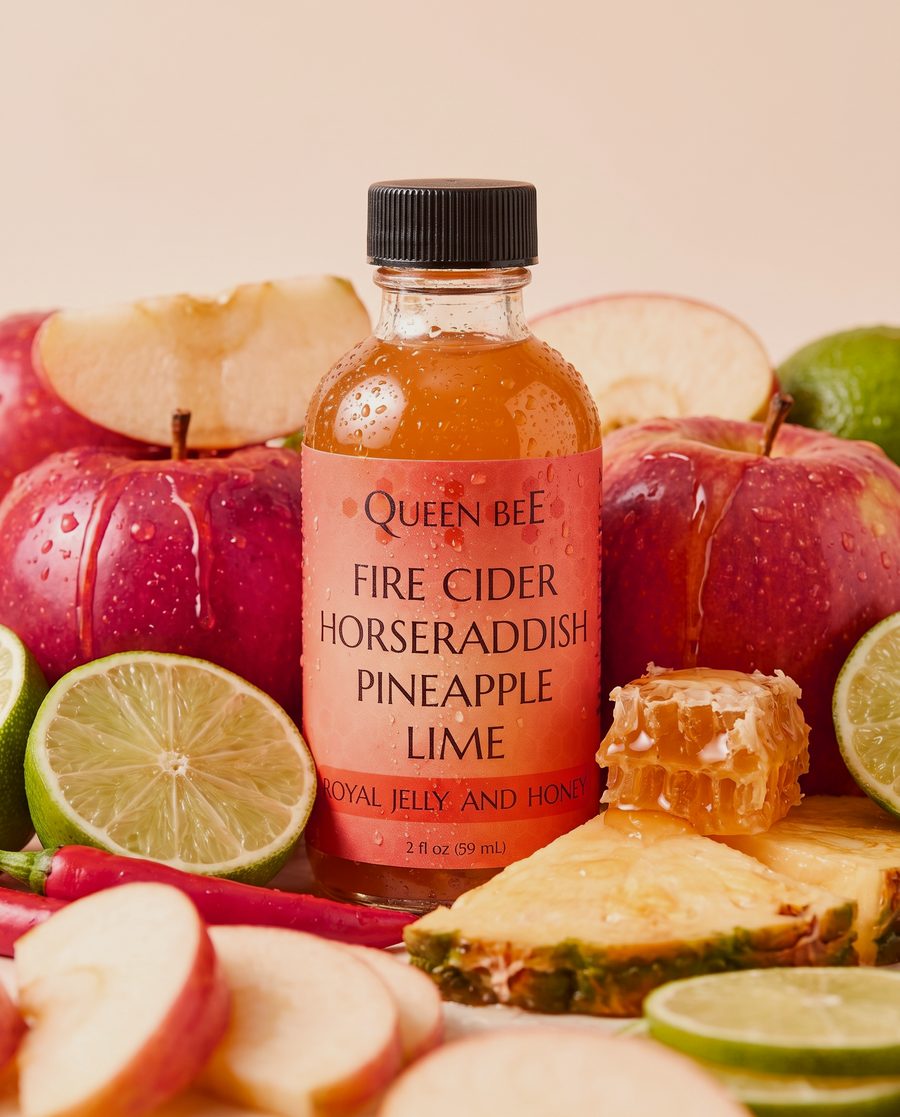
One of those is ours. The Queen Bee Fire Cider wellness shot is made with apple cider vinegar, pineapple, ginger, horseradish, honey, lime, turmeric, cayenne and royal jelly. It is cold-pressed, never heat-treated, in a 2 oz glass bottle. It is our digestion shot, built to support gut comfort after meals.
| Homemade | Queen Bee shot | |
|---|---|---|
| Time | About 4 weeks | Made the day your order ships |
| Base | Apple cider vinegar | Apple cider vinegar and pineapple |
| Garlic and onion | Yes | No |
| Sweetener | Honey, to taste | Raw honey and royal jelly |
| Serving | About 1 tablespoon, diluted | One 2 oz bottle |
| Storage | Refrigerate; use within about 3 months | Shelf stable until opened; refrigerate after opening and finish within a week |
Homemade wins on cost and control. Ready-made wins on time. Our shot contains royal jelly, which people allergic to bee products should avoid (Memorial Sloan Kettering). See how it compares with our Ginger shot in fire cider vs ginger shot, or read homemade vs store-bought wellness shots.
FAQ
How much fire cider should I take a day?
About 1 tablespoon once or twice a day is common, diluted in water. Healthline lists up to 2 to 3 tablespoons a day or one 1.5 oz shot (Healthline).
Is fire cider good for you?
It is a flavorful way to get garlic, ginger, horseradish and peppers into your day, but no study has tested the tonic itself (Healthline). Of its ingredients, ginger has the most research. Keep it diluted to protect your teeth and throat.
Does it need to be refrigerated?
Yes, once strained. Steep it in a cool, dark cupboard, then keep the finished tonic in the fridge and use it within about 3 months (UAF Extension).
No time to steep a batch? Our shot brings apple cider vinegar, ginger, horseradish and pineapple together in one 2 oz glass bottle, finished with raw honey and royal jelly.
See the Fire Cider shot →Key takeaways
- Steep garlic, ginger, horseradish, onion, peppers and citrus in apple cider vinegar for about 4 weeks, strain, add honey
- Rosemary Gladstar popularized it in the late 1970s; the name has been generic since 2019
- Refrigerate after straining, use within about 3 months, and toss it if it molds or bubbles
- About 1 tablespoon a day, always diluted, is the common amount
- No study has tested the tonic itself; ginger has the most research of its ingredients
Sources: Healthline · UAF Extension, Flavored Vinegars · Mayo Clinic, Apple Cider Vinegar · NIH NCCIH, Ginger · NIH NCCIH, Garlic · NIH NCCIH, Turmeric · Oxymel review, Heliyon 2023 · WAMC · CDC